
Decoding the International Code Council pt. 1

As I’ve described previously, the International Code Council (ICC) is a strange beast in the pantheon of American organizations. Nominally, it is a non-profit association of building officials and construction industry groups that determines residential and commercial building codes in the US — everything from how soundproof your walls must be1 to how many toilets your office has2. State and local officials do not have the expertise or resources3 to independently come to their own determination about what constitutes a good building, so they wholesale adopt the codes of the ICC into their local laws with minor modifications. It is hard to think of another private institution in American life that has near copy-and-paste access to the lawbooks. This mechanism is how the ICC invisibly decides vast swathes of the built environment that Americans inhabit everyday.4
Much progress has been made towards reducing America’s housing shortage by reforming our zoning laws. The next frontier is reducing construction cost, which represent about 65% of the cost of a home5.
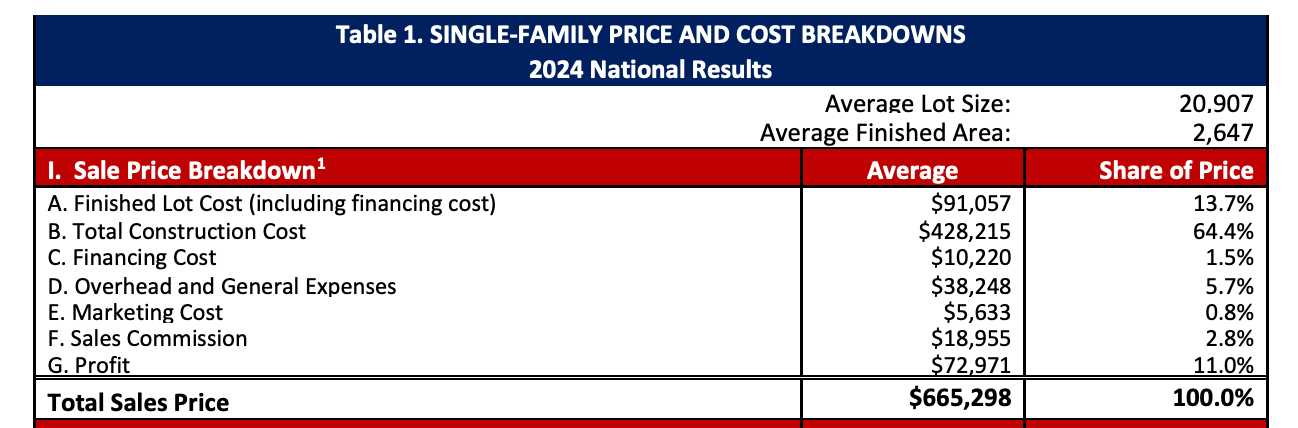
In this context, scrutiny of the ICC has intensified. Some have criticized specific rules that add unnecessary cost and others6 have examined the process7 by which the ICC decides the standards8 to promulgate.
My contribution to this movement is to understand the ICC as an organization in and of itself, separate from the building codes. I will analyze its public documents such as filings and governance records. I hope these breadcrumbs can help others in the movement drive real reform.
The 2024 IRS Form 990
For today’s article, I have combed through the ICC’s latest (2024) 990 filing and associated schedules9, which is the annual tax filing for a non-profit.10
Basic Facts
The ICC is based in Country Club Hills, IL.11 It is organized as a 501(c)(6), a tax-exempt designation which is reserved for business leagues that promote the overall welfare of a business interest (think Chamber of Commerce).12 The organization employs 622 people and brought in net profits of $7.8M in 2024 compared to $6.2M in 2023.
Revenue Breakdown
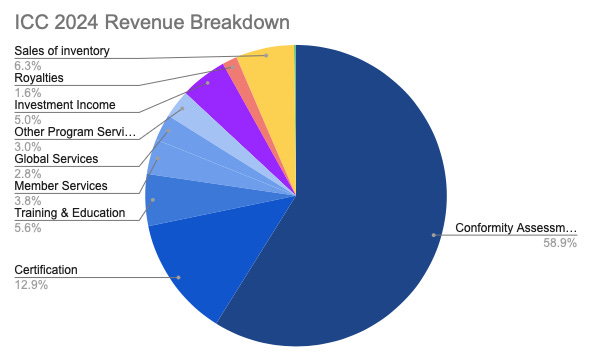
Of the $110M in revenue in 2024, “program services”13 represent $95M. The ICC describes its top three program services as:
Conformity assessments: “The ICC acts as a single-source conformity assessment solution … product evaluation reports, inspection, and laboratory testing fees”
Publishing and content services: these are the royalties and sales of printed contents and digital access to the codes.
Member services: training, education, and certification.
The lion’s share of program service revenue comes from the Conformity Assessments at $65M distantly followed by “Certification” at $14M.
In the $15M of revenue not considered program services, sales from inventory — which I take to mean books and other code-related publications — are $6.8M, investment income off its sizable $61M nest egg of marketable securities is $5.5M, and royalties is $1.7M.
Assessing Conformity Assessments
Revenue source reveals the true priorities of the organization and the picture that emerges is that the ICC’s primary business is to perform the conformity assessment services. This was a surprise to me. My perception (and the projection) of the ICC is that it is a collection of building inspectors, structural engineers, and developers. They get together to write the codes, train their junior members, and certify them to the world. Maybe they do some lobbying too. But this member-driven part of the business is $32M of revenue14, half the conformity assessment services.
To reiterate, its bread and butter is conducting analyses that its own codes require.15 It gets to decide what are the requirements, those get copied and pasted into the laws, and then it charges for the required analyses.
And the behavior of the organization follows: it aggressively defends its codes from use by private actors. I am not privy to their internal deliberations, but I speculate that their strategy is to give the code away for free to municipalities and their building inspectors, then charge a license for private actors such as engineers and architects to reference the codes in their work. Anyone who wishes to interpret the codes (whether by human intelligence or otherwise) for profit must pay the ICC a tax. Accordingly, its major moves have been to defends its prerogative over the codes. It sued the startup Upcodes for making its codes available on the internet without paying a license (a court ruled against the ICC in 2025, finding that text that have been adopted into laws cannot be copyrighted).16 The ICC then responded by lobbying Congress to pass a carveout which would overrule the court (the Pro Codes Act, which is in the House as of this writing).17 This strategic initiative to lock down its ownership of the codes is ongoing. It attracts the energy of senior leadership that indicates it is of high priority.
Stay Tuned…
Just looking at the revenue part of the most recent public disclosures revealed that the ICC’s core business is different from common perception. A non-profit's tax exemption rests on what it actually does, not what it says it does. In Part 2, we look at the foundations of the ICC’s 501(c)(6) status and how our newfound understanding of its business might intersect with new rulings to impact this status.